

visits Abraham birthplace
In Ur, the birthplace of the Prophet Abraham, the common patriarch of Judaism, Christianity, and Islam, Pope Francis met with representatives of multiple religions and appealed to their common history, calling for fraternity and dedication to helping society’s most vulnerable
Click to enlarge
“There will be no peace, as long as our alliances are against others,” said the pope to the gathering of Christians, Muslims, Yazidis, Sabeans, and other Iraqi faiths.
Ur, in Iraq’s Nasiriyah province, is one of the world’s oldest cities. The Bible describes God calling Abraham to leave Ur and settle the land of Canaan. “Brothers and sisters of different religions, here we find ourselves at home,” Pope Francis said.
“From this place, where faith was born, from the land of our father Abraham, let us affirm that God is merciful and that the greatest blasphemy is to profane his name by hating our brothers and sisters. Hostility, extremism and violence are not born of a religious heart: they are betrayals of religion.”
Nasiriyah has seen some of the bloodiest anti-government protests since 2019 when demonstrators took to the streets demanding improved government services and an end to corruption. A week before the pope’s visit, ten people were killed in Nasiriyah when security forces opened fire on protests.
In November 2003, at least 28 people, including 19 Italians, were killed in Nasiriyah in a bombing of an Italian complex.
The interfaith event began with reading passages from the Bible and Quran about Abraham and Ur and the pope heard personal testimonies from representatives of different faiths.
Two boys, Daoud and Hassan, a Christian and a Muslim, from Basra recounted how they have grown up together and established a small business. “Though we are not of the same religion, our story shows that we can work together and we can be friends… We don’t want war and violence and hatred. We would like the people of our country to work together and be friends,” said Hassan.
The pope commended the friendship of the two boys as a model of a way to build the future.
“It is up to us, today’s humanity, especially those of us, believers in religion, to turn instruments of hatred into instruments of peace,” said Pope Francis. “It is up to us to appeal firmly to the leaders of nations to make increasing proliferation of arms give way to the distribution of food for all. It is up to us to silence mutual accusations, in order to make heard the cry of the oppressed and those who are discarded in our world. All too many people lack food, medicine, education, rights, and dignity. It is up to us to shed light on the shady maneuvers that revolve around money.”
Pope Francis made special mention of the Yazidi community, “which has mourned the deaths of many men and witnessed thousands of women, girls, and children kidnapped, sold as slaves, subjected to physical violence and forced conversions.”
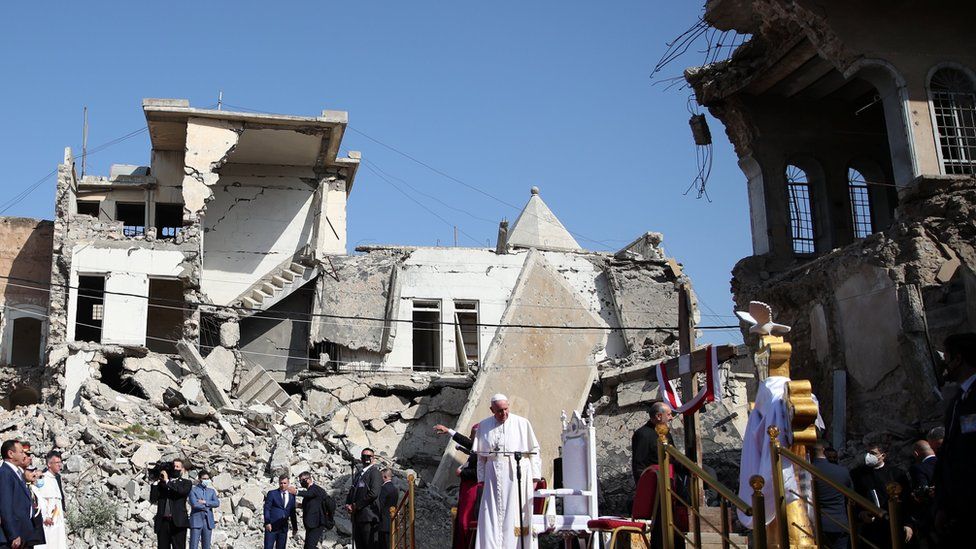
He praised the fraternity of Muslim and Christians in Mosul, working together to rebuild mosques and churches damaged in the war against the Islamic State group (ISIS).
Pope Francis also mentioned Syria, appealing for peace in the neighbouring war-torn country.
The pope urged people to work together and help each other during the COVID-19 pandemic. “We need each other. The pandemic has made us realize that no one is saved alone,” he said.
https://www.rudaw.net/english/middleeast/iraq/06032021