

Facebook

Search

Welcome To Roj Bash Kurdistan

Kurdistan forces are liberating Western Kurdistan
Qamishlo - 18 July
 Author: alan131210 » Thu Jul 26, 2012 7:56 am
…………………………………………………………
KERKUK is the Heart of Kurdistan
Kurdish state is on the horizon with WK now freed great kurdistan is closing in.
KERKUK is the Heart of Kurdistan
Kurdish state is on the horizon with WK now freed great kurdistan is closing in.
-
alan131210 - Shaswar

- Posts: 9079
- Images: 2
- Joined: Fri Oct 08, 2010 12:23 am
- Location: Kurdistan
- Highscores: 0
- Arcade winning challenges: 0
- Has thanked: 4837 times
- Been thanked: 4390 times
- Nationality: Kurd
some good articles
Author: alan131210 » Thu Jul 26, 2012 8:11 am
…………………………………………………………
KERKUK is the Heart of Kurdistan
Kurdish state is on the horizon with WK now freed great kurdistan is closing in.
KERKUK is the Heart of Kurdistan
Kurdish state is on the horizon with WK now freed great kurdistan is closing in.
-
alan131210 - Shaswar
- Posts: 9079
- Images: 2
- Joined: Fri Oct 08, 2010 12:23 am
- Location: Kurdistan
- Highscores: 0
- Arcade winning challenges: 0
- Has thanked: 4837 times
- Been thanked: 4390 times
- Nationality: Kurd
Westen Kurdistan
Author: alan131210 » Thu Jul 26, 2012 8:14 am

…………………………………………………………
KERKUK is the Heart of Kurdistan
Kurdish state is on the horizon with WK now freed great kurdistan is closing in.
KERKUK is the Heart of Kurdistan
Kurdish state is on the horizon with WK now freed great kurdistan is closing in.
-
alan131210 - Shaswar
- Posts: 9079
- Images: 2
- Joined: Fri Oct 08, 2010 12:23 am
- Location: Kurdistan
- Highscores: 0
- Arcade winning challenges: 0
- Has thanked: 4837 times
- Been thanked: 4390 times
- Nationality: Kurd
Re: Kurdistan forces are liberating Western Kurdistan
Author: alan131210 » Thu Jul 26, 2012 8:19 am
^^^ if only that part between WK and med sea was not turkey's 
…………………………………………………………
KERKUK is the Heart of Kurdistan
Kurdish state is on the horizon with WK now freed great kurdistan is closing in.
KERKUK is the Heart of Kurdistan
Kurdish state is on the horizon with WK now freed great kurdistan is closing in.
-
alan131210 - Shaswar
- Posts: 9079
- Images: 2
- Joined: Fri Oct 08, 2010 12:23 am
- Location: Kurdistan
- Highscores: 0
- Arcade winning challenges: 0
- Has thanked: 4837 times
- Been thanked: 4390 times
- Nationality: Kurd
Re: Kurdistan forces are liberating Western Kurdistan
Author: alan131210 » Thu Jul 26, 2012 8:27 am
…………………………………………………………
KERKUK is the Heart of Kurdistan
Kurdish state is on the horizon with WK now freed great kurdistan is closing in.
KERKUK is the Heart of Kurdistan
Kurdish state is on the horizon with WK now freed great kurdistan is closing in.
-
alan131210 - Shaswar
- Posts: 9079
- Images: 2
- Joined: Fri Oct 08, 2010 12:23 am
- Location: Kurdistan
- Highscores: 0
- Arcade winning challenges: 0
- Has thanked: 4837 times
- Been thanked: 4390 times
- Nationality: Kurd
Re: Kurdistan forces are liberating Western Kurdistan
Author: alan131210 » Thu Jul 26, 2012 8:42 am
A few days before last week's attack that killed four of Assad's top aides in Damascus, the main Syrian Kurdish groups – the Kurdish National Councils (KNC) and the Democratic Union party (PYD) – signed an important agreement in Erbil to set up a Supreme Kurdish Council to co-ordinate their efforts.
They agreed to form a popular defence force consisting mainly of Kurdish Syrian soldiers who have defected to Iraqi Kurdistan since the uprising began in March last year. These soldiers are being retrained in military camps funded by the oil-rich KRG and are preparing to enter the Kurdish areas in Syria to defend towns such as Kobani (Ayn al-Arab) that are in the hands of the Kurdish activists.
http://www.guardian.co.uk/commentisfree ... al-council
as you can see there , PYD has formed its own armed groups and thus it has breached the Hawler agreement

…………………………………………………………
KERKUK is the Heart of Kurdistan
Kurdish state is on the horizon with WK now freed great kurdistan is closing in.
KERKUK is the Heart of Kurdistan
Kurdish state is on the horizon with WK now freed great kurdistan is closing in.
-
alan131210 - Shaswar
- Posts: 9079
- Images: 2
- Joined: Fri Oct 08, 2010 12:23 am
- Location: Kurdistan
- Highscores: 0
- Arcade winning challenges: 0
- Has thanked: 4837 times
- Been thanked: 4390 times
- Nationality: Kurd
The Kurdish Flag Flies over Parts of Syria as Aleppo Ignites
Author: alan131210 » Thu Jul 26, 2012 9:05 am

Wednesday, July 25th, 2012
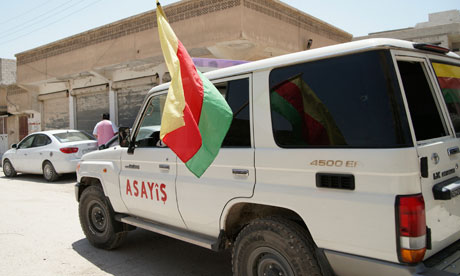
Many Kurdish towns in the Northeast of Syria are now flying the Kurdish flag as Syrian troops have withdrawn from the region to fight back the offensives in Syria’s two largest cities. BBC reports that fighter jets strafed parts of Aleppo.
This seems to be their first use and a clear escalation. Turkey has closed its border with Syria, halting the passage of all commercial vehicles between Turkey and Syria. Only refugees can cross into Syria. The borders are too dangerous.
http://www.joshualandis.com/blog/?p=15532
…………………………………………………………
KERKUK is the Heart of Kurdistan
Kurdish state is on the horizon with WK now freed great kurdistan is closing in.
KERKUK is the Heart of Kurdistan
Kurdish state is on the horizon with WK now freed great kurdistan is closing in.
-
alan131210 - Shaswar
- Posts: 9079
- Images: 2
- Joined: Fri Oct 08, 2010 12:23 am
- Location: Kurdistan
- Highscores: 0
- Arcade winning challenges: 0
- Has thanked: 4837 times
- Been thanked: 4390 times
- Nationality: Kurd
Kurdish Liberation Movement in Syria Continues Despite Criti
Author: alan131210 » Thu Jul 26, 2012 9:13 am

26/07/2012 06:02:00 By ADIB ABDULMAJID
AMSTERDAM, Netherlands – The Kurdish Supreme Committee – a coalition of the Kurdish National Council (KNC) and the People’s Council of Western Kurdistan – held its first meeting since Kurdish areas in Syria were liberated from the regime.
Held in Qamishli on Tuesday, the meeting discussed the recent developments in the Kurdish areas and their future in a post-Assad era.
Sinem Khalil, a member of the Kurdish Supreme Committee, said that the meeting represented the practical implementation of the agreement signed earlier this month between the KNC and the Democratic Union Party (PYD) in Erbil.
“The Kurdish people in Syria are thirsty for unity that will help achieve their aspirations, and that is our main focus now,” Khalil said. “The current stage of this revolution is very sensitive, and what we have achieved so far in the Kurdish areas in Syria proves the level of responsibility reached between the different Kurdish factions.”
He added, “I believe that our Kurdish dream is coming true.”
Following the withdrawal of Syrian President Bashar al-Assad’s forces from a number of Kurdish areas, more than six towns were declared liberated, including Kobane, Efrin, Amude, Derek, Girke Lege and Dirbesiye. The Kurdish flag was raised on government buildings in these areas.
But the Kurdish liberation movement has been criticized by both Kurdish and Arab politicians.
In a press conference on Monday, Abdulbasit Sieda, a prominent Kurdish politician and president of the Syrian National Council (SNC), accused some Kurdish factions – particularly the Democratic Union Party (PYD) and the KNC – of cooperating with the Syrian regime in order to take over Kurdish parts of Syria.
“The areas where these Kurdish factions have raised their flags are those Bashar al-Assad gave to them,” Sieda said, minimizing the achievement of Syrian Kurds.
Sieda added that the Kurds have been a main participant in the ongoing pro-democracy revolution in Syria. “But some sides have their own agenda which does not serve the Syrian national issue,” he said.
Sieda’s statements angered many Kurdish activists in Syria.
Taha Alhamid, a Kurdish member of the Syrian Journalists Association, described Sieda’s remarks as “careless” at a time when different elements of Syrian society are trying to entrench themselves in their areas to preserve their rights and receive support.
“Mr. Sieda’s statements show his carelessness about the future of the Kurdish people in Syria and the kind of persecution and discrimination this future might hold for Kurds who are struggling against the tyrannical regime of Assad on the one hand, and the chauvinistic and Salafist opposition on the other,” Alhamid wrote.
According to Alhamid, Sieda is turning a blind eye to the control the Salafists and Jihadists have on a large area of the country, and “criticizing the Kurdish achievement of liberating and protecting” their areas.
http://www.rudaw.net/english/news/syria/5004.html
…………………………………………………………
KERKUK is the Heart of Kurdistan
Kurdish state is on the horizon with WK now freed great kurdistan is closing in.
KERKUK is the Heart of Kurdistan
Kurdish state is on the horizon with WK now freed great kurdistan is closing in.
-
alan131210 - Shaswar
- Posts: 9079
- Images: 2
- Joined: Fri Oct 08, 2010 12:23 am
- Location: Kurdistan
- Highscores: 0
- Arcade winning challenges: 0
- Has thanked: 4837 times
- Been thanked: 4390 times
- Nationality: Kurd
Alan Kirkuki Browse|Movies |Upload Inside Story - Appeasing
Author: alan131210 » Thu Jul 26, 2012 9:18 am
…………………………………………………………
KERKUK is the Heart of Kurdistan
Kurdish state is on the horizon with WK now freed great kurdistan is closing in.
KERKUK is the Heart of Kurdistan
Kurdish state is on the horizon with WK now freed great kurdistan is closing in.
-
alan131210 - Shaswar
- Posts: 9079
- Images: 2
- Joined: Fri Oct 08, 2010 12:23 am
- Location: Kurdistan
- Highscores: 0
- Arcade winning challenges: 0
- Has thanked: 4837 times
- Been thanked: 4390 times
- Nationality: Kurd
Re: Kurdish Liberation Movement in Syria Continues Despite C
Author: Kulka » Thu Jul 26, 2012 9:25 am
alan131210 wrote:
26/07/2012 06:02:00 By ADIB ABDULMAJID
http://www.rudaw.net/english/news/syria/5004.html
I think know two of these people from the pic personally. The one with blue shirt and the one with the scarf - if its him - so its the same guy who last year in march was arrested during our demonstration, when he wrote something on the wall of Syrian ambassy with red marker

-

Kulka - Shaswar
- Posts: 2042
- Joined: Mon Mar 03, 2008 6:20 pm
- Location: Wolverhampton, West Middlands, United Kingdom
- Highscores: 0
- Arcade winning challenges: 0
- Has thanked: 70 times
- Been thanked: 266 times
- Nationality: Kurd
PYD Leader Says Peshmerga Will be Called into Syria When Nee
Author: alan131210 » Thu Jul 26, 2012 9:31 am
…………………………………………………………
KERKUK is the Heart of Kurdistan
Kurdish state is on the horizon with WK now freed great kurdistan is closing in.
KERKUK is the Heart of Kurdistan
Kurdish state is on the horizon with WK now freed great kurdistan is closing in.
-
alan131210 - Shaswar
- Posts: 9079
- Images: 2
- Joined: Fri Oct 08, 2010 12:23 am
- Location: Kurdistan
- Highscores: 0
- Arcade winning challenges: 0
- Has thanked: 4837 times
- Been thanked: 4390 times
- Nationality: Kurd
Re: Kurdistan forces are liberating Western Kurdistan
Author: alan131210 » Thu Jul 26, 2012 9:39 am
Erdogan describes Kurds as terrorists. Palestinians as heroes. http://pic.twitter.com/kHasg9y6
…………………………………………………………
KERKUK is the Heart of Kurdistan
Kurdish state is on the horizon with WK now freed great kurdistan is closing in.
KERKUK is the Heart of Kurdistan
Kurdish state is on the horizon with WK now freed great kurdistan is closing in.
-
alan131210 - Shaswar
- Posts: 9079
- Images: 2
- Joined: Fri Oct 08, 2010 12:23 am
- Location: Kurdistan
- Highscores: 0
- Arcade winning challenges: 0
- Has thanked: 4837 times
- Been thanked: 4390 times
- Nationality: Kurd
Turkish FM to discuss Syrian crisis with south Kurdistan
Author: alan131210 » Thu Jul 26, 2012 9:42 am

ANKARA, — Turkish foreign minister, Ahmet Davutoğlu, will arrive in the Kurdistan Region next week, said Turkish 24 Channel.
During an interview Turkish Prime Minister Recep Tayyip Erdoğan told the TV channel that he will send Davutoğlu to Kurdistan to discuss with Kurdish officials the Syrian crisis and the situation of the areas which Syrian Kurds have controlled.
Erdoğan added Turkey does not intend to uproot Kurds in Syria and it cannot interfere in Kurds' affairs "but it's impossible to tenderly look at the relation between the terrorist Kurdistan Workers Party (PKK) and the Democratic Union Party (PYD)."
He added the entity in Syria cannot be regarded as "Kurdish…because it is the entity of the terrorist PKK and PYD."
PKK has offshoots in Iran, Syria and Iraq, where major Kurdish communities reside.
The PKK has several times proposed peaceful solutions regarding Kurdish problem,www.ekurd.net Turkey has always refused saying that it will not negotiate with “terrorists”.
Since it was established in 1984, the PKK has been fighting the Turkish state, which still denies the constitutional existence of Kurds, to establish a Kurdish state in the south east of the country.
But now its aim is the creation an autonomous region and more cultural rights for ethnic Kurds who constitute the greatest minority in Turkey, numbering more than 20 million. A large Turkey's Kurdish community openly sympathise with the Kurdish PKK rebels.
The PKK wants constitutional recognition for the Kurds, regional self-governance and Kurdish-language education in schools.
PKK's demands included releasing PKK detainees, lifting the ban on education in Kurdish, paving the way for an autonomous democrat Kurdish system within Turkey, reducing pressure on the detained PKK leader Abdullah Öcalan, stopping military action against the Kurdish party and recomposing the Turkish constitution.
Turkey refuses to recognize its Kurdish population as a distinct minority. It has allowed some cultural rights such as limited broadcasts in the Kurdish language and private Kurdish language courses with the prodding of the European Union, but Kurdish politicians say the measures fall short of their expectations.
The PKK is considered as 'terrorist' organization by Ankara, U.S., the PKK continues to be on the blacklist list in EU despite court ruling which overturned a decision to place the Kurdish rebel group PKK and its political wing on the European Union's terror list.
By Hewar Ismael - AK News - Ekurd.net contributed to this report
…………………………………………………………
KERKUK is the Heart of Kurdistan
Kurdish state is on the horizon with WK now freed great kurdistan is closing in.
KERKUK is the Heart of Kurdistan
Kurdish state is on the horizon with WK now freed great kurdistan is closing in.
-
alan131210 - Shaswar
- Posts: 9079
- Images: 2
- Joined: Fri Oct 08, 2010 12:23 am
- Location: Kurdistan
- Highscores: 0
- Arcade winning challenges: 0
- Has thanked: 4837 times
- Been thanked: 4390 times
- Nationality: Kurd
Re: Kurdistan forces are liberating Western Kurdistan
Author: alan131210 » Thu Jul 26, 2012 9:48 am
Head of the Syrian National Council (SNC): “We are constantly in touch with Barzani regarding the situation in Syria" http://is.gd/vXfltC
…………………………………………………………
KERKUK is the Heart of Kurdistan
Kurdish state is on the horizon with WK now freed great kurdistan is closing in.
KERKUK is the Heart of Kurdistan
Kurdish state is on the horizon with WK now freed great kurdistan is closing in.
-
alan131210 - Shaswar
- Posts: 9079
- Images: 2
- Joined: Fri Oct 08, 2010 12:23 am
- Location: Kurdistan
- Highscores: 0
- Arcade winning challenges: 0
- Has thanked: 4837 times
- Been thanked: 4390 times
- Nationality: Kurd
Re: Kurdistan forces are liberating Western Kurdistan
Author: alan131210 » Thu Jul 26, 2012 9:58 am
…………………………………………………………
KERKUK is the Heart of Kurdistan
Kurdish state is on the horizon with WK now freed great kurdistan is closing in.
KERKUK is the Heart of Kurdistan
Kurdish state is on the horizon with WK now freed great kurdistan is closing in.
-
alan131210 - Shaswar
- Posts: 9079
- Images: 2
- Joined: Fri Oct 08, 2010 12:23 am
- Location: Kurdistan
- Highscores: 0
- Arcade winning challenges: 0
- Has thanked: 4837 times
- Been thanked: 4390 times
- Nationality: Kurd
Return to Kurdistan Debates, Articles and Analysis
Who is online
Registered users: Bing [Bot], Google Adsense [Bot], Majestic-12 [Bot]